- Lecturer: Innocent Dr KABAGEMA
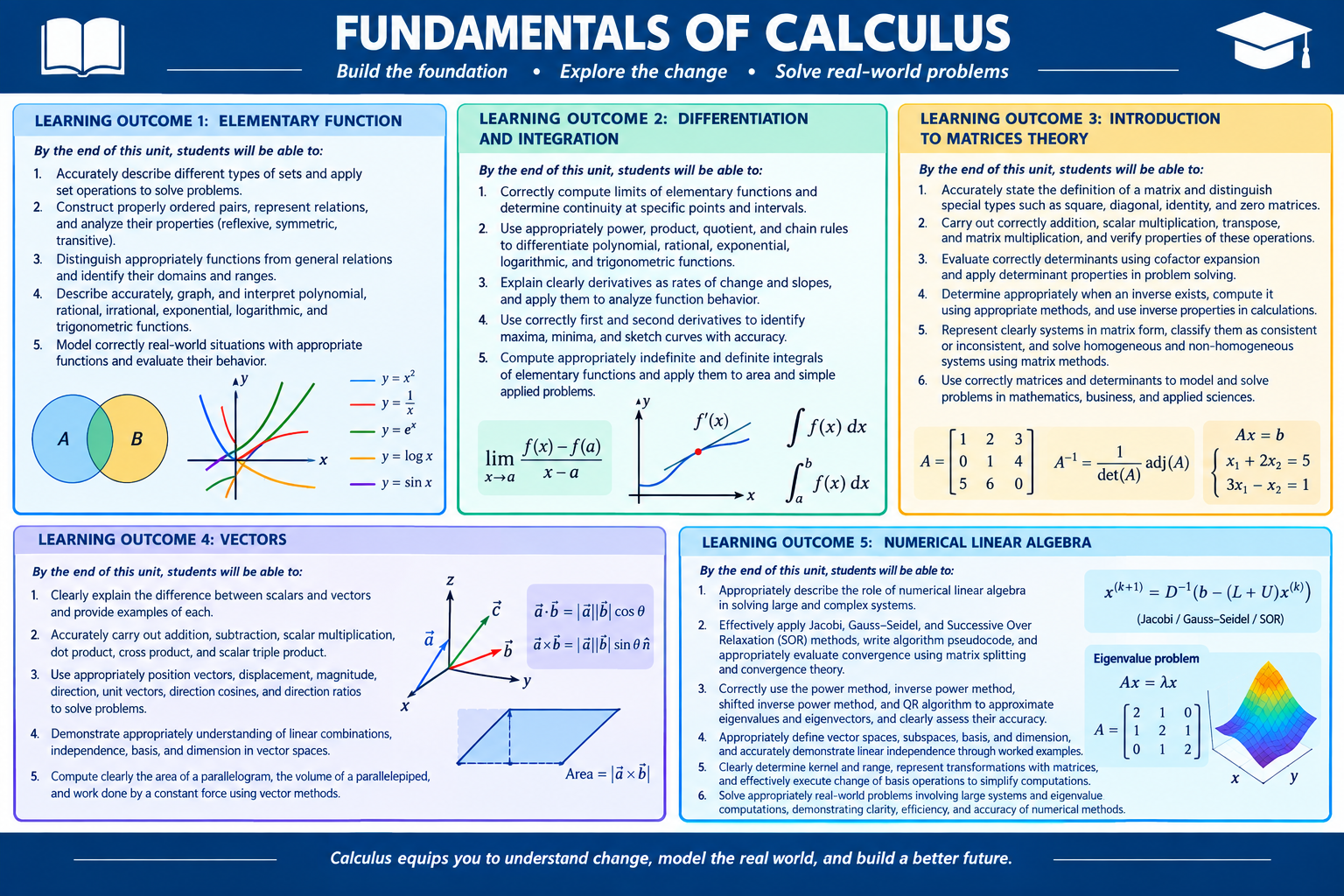
Fundamentals of Mathematics provides a comprehensive foundation in the mathematical tools essential for engineering and applied sciences, spanning set theory, functions, calculus, linear algebra, vectors, and numerical methods. The course develops students' understanding of sets and set operations, ordered pairs and relations, and the properties (reflexive, symmetric, transitive) that distinguish them, before progressing to functions including polynomial, rational, irrational, exponential, logarithmic, and trigonometric functions and their graphical interpretation and real-world modeling.
The course then introduces the core concepts of calculus, covering limits and continuity of elementary functions, differentiation using power, product, quotient, and chain rules, and the interpretation of derivatives as rates of change and slopes. Students apply first and second derivatives to analyze function behavior, identify maxima and minima, and sketch curves, before extending to indefinite and definite integrals and their applications to area and simple applied problems.
Building on this foundation, the course develops matrix theory and linear algebra, including special types of matrices, matrix operations (addition, scalar multiplication, transpose, multiplication), determinants and cofactor expansion, matrix inverses, and the representation and solution of linear systems in matrix form. These tools are applied to model and solve problems in mathematics, business, and applied sciences.
The course further introduces vectors and vector spaces, distinguishing scalars from vectors and covering vector operations (addition, dot product, cross product, scalar triple product), position vectors, magnitude, direction, and unit vectors, as well as linear combinations, independence, basis, and dimension. Students apply vector methods to compute areas, volumes, and work done by a force.
Finally, the course covers numerical linear algebra, introducing its role in solving large and complex systems through iterative methods (Jacobi, Gauss–Seidel, SOR) and eigenvalue approximation techniques (power method, inverse power method, QR algorithm). Students further explore vector spaces, subspaces, kernel and range, and change of basis, applying these concepts to solve real-world problems involving large systems with clarity, efficiency, and accuracy.
Throughout the course, students are encouraged to develop rigorous mathematical reasoning, computational skills, and the ability to apply mathematical and numerical methods to solve problems across engineering, business, and applied sciences.
The course then introduces the core concepts of calculus, covering limits and continuity of elementary functions, differentiation using power, product, quotient, and chain rules, and the interpretation of derivatives as rates of change and slopes. Students apply first and second derivatives to analyze function behavior, identify maxima and minima, and sketch curves, before extending to indefinite and definite integrals and their applications to area and simple applied problems.
Building on this foundation, the course develops matrix theory and linear algebra, including special types of matrices, matrix operations (addition, scalar multiplication, transpose, multiplication), determinants and cofactor expansion, matrix inverses, and the representation and solution of linear systems in matrix form. These tools are applied to model and solve problems in mathematics, business, and applied sciences.
The course further introduces vectors and vector spaces, distinguishing scalars from vectors and covering vector operations (addition, dot product, cross product, scalar triple product), position vectors, magnitude, direction, and unit vectors, as well as linear combinations, independence, basis, and dimension. Students apply vector methods to compute areas, volumes, and work done by a force.
Finally, the course covers numerical linear algebra, introducing its role in solving large and complex systems through iterative methods (Jacobi, Gauss–Seidel, SOR) and eigenvalue approximation techniques (power method, inverse power method, QR algorithm). Students further explore vector spaces, subspaces, kernel and range, and change of basis, applying these concepts to solve real-world problems involving large systems with clarity, efficiency, and accuracy.
Throughout the course, students are encouraged to develop rigorous mathematical reasoning, computational skills, and the ability to apply mathematical and numerical methods to solve problems across engineering, business, and applied sciences.
- Lecturer: EMMANUEL NTAWUHIGANAYO
- Lecturer: Vincent UWAYEZU
- Lecturer: Innocent Dr KABAGEMA