- Lecturer: Honore ISHIMWE
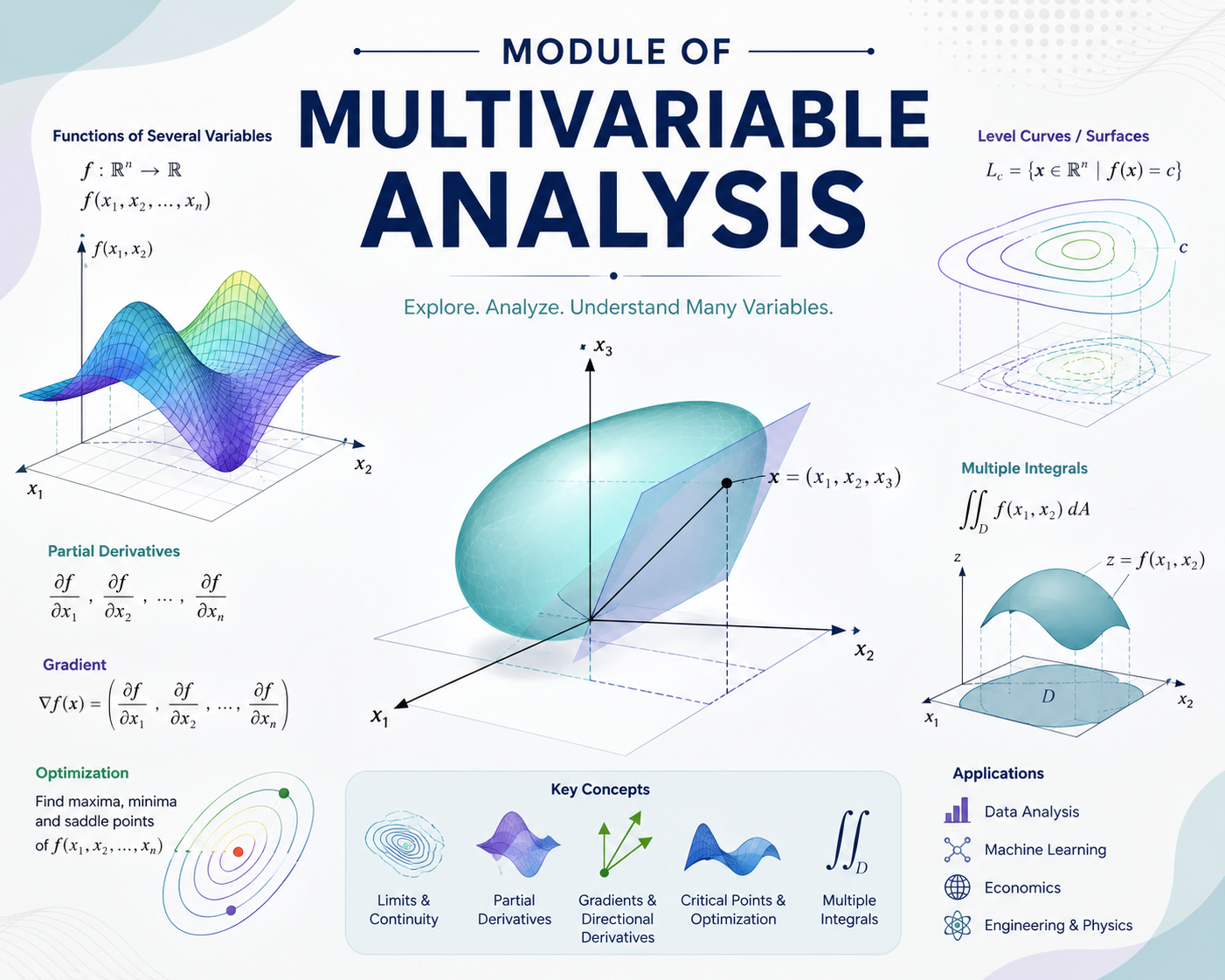
The course is organized into three interconnected Chapters:
1.Differential Calculus:
You learn how to study functions of several variables using ideas such as regions and continuity, limits, partial derivatives, directional derivatives, and the gradient. The section also develops tools like the chain rule, Taylor’s theorem, and methods to find local/absolute extrema. Finally, it introduces Lagrange multipliers for optimizing a function subject to constraints.
2.Multiple Integrals:
Here, the focus shifts to measuring quantities over regions in the plane and space. You build up from double integrals (for area and volume) to triple integrals (for volumes in 3D), including practical techniques such as iterated integrals, Fubini’s theorem, and choosing convenient coordinate systems (polar, cylindrical, spherical). The notes also explain change of variables using Jacobians.
3.Vector Integrals:
The final part develops integration for vector fields, including line integrals, surface integrals, and the relationship between them using powerful theorems. It introduces key concepts like conservative vector fields, curl and divergence, and culminates with three major results:
o Green’s theorem (2D),
o Stokes’ theorem (turning line integrals into surface integrals in 3D),
o Gauss’ divergence theorem (relating flux across a closed surface to a triple integral over the enclosed region).
1.Differential Calculus:
You learn how to study functions of several variables using ideas such as regions and continuity, limits, partial derivatives, directional derivatives, and the gradient. The section also develops tools like the chain rule, Taylor’s theorem, and methods to find local/absolute extrema. Finally, it introduces Lagrange multipliers for optimizing a function subject to constraints.
2.Multiple Integrals:
Here, the focus shifts to measuring quantities over regions in the plane and space. You build up from double integrals (for area and volume) to triple integrals (for volumes in 3D), including practical techniques such as iterated integrals, Fubini’s theorem, and choosing convenient coordinate systems (polar, cylindrical, spherical). The notes also explain change of variables using Jacobians.
3.Vector Integrals:
The final part develops integration for vector fields, including line integrals, surface integrals, and the relationship between them using powerful theorems. It introduces key concepts like conservative vector fields, curl and divergence, and culminates with three major results:
o Green’s theorem (2D),
o Stokes’ theorem (turning line integrals into surface integrals in 3D),
o Gauss’ divergence theorem (relating flux across a closed surface to a triple integral over the enclosed region).
- Lecturer: Benjamin HAFASHIMANA
- Lecturer: Jean Claude HARINDIMANA
- Lecturer: Alexis MANISHIMWE
- Lecturer: Maurice TURINUMUKIZA
- Lecturer: Vedaste UWIHANGANYE