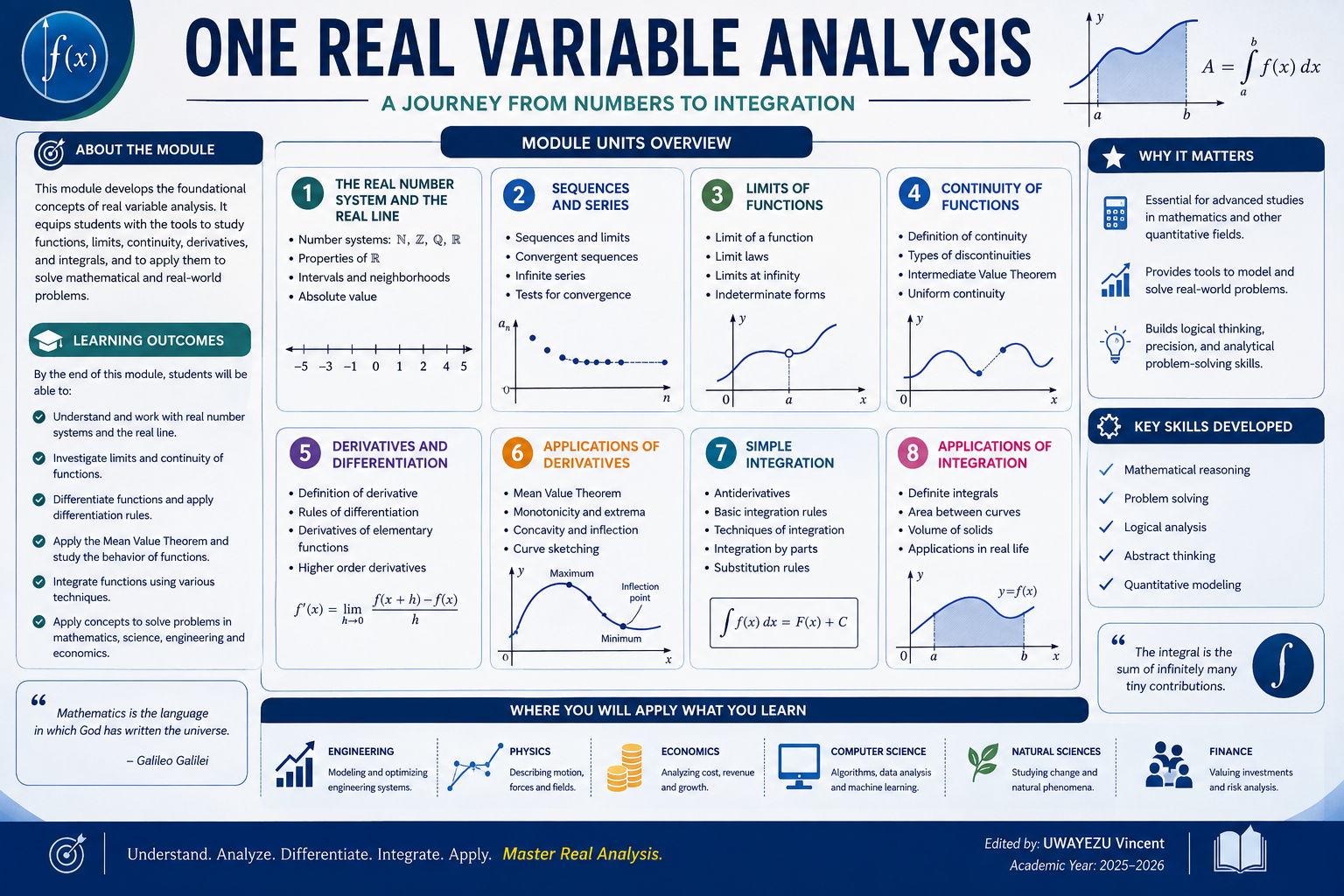
**One Real Variable Analysis** provides a rigorous study of the fundamental concepts and principles underlying the analysis of real-valued functions of one real variable. The course develops students' understanding of the real number system (ℕ, ℤ, ℚ, ℝ), the properties of ℝ, intervals and neighborhoods, and absolute value, laying the groundwork for a precise treatment of functions on the real line.
The course introduces the concepts of sequences, series, limits, and continuity, emphasizing both intuitive and rigorous approaches to convergence, limit laws, limits at infinity, and indeterminate forms. Students examine the continuity and discontinuity of functions, the Intermediate Value Theorem, and uniform continuity, developing the ability to justify analytical results using appropriate mathematical arguments.
The course further develops the theory and applications of differentiation, including the definition of the derivative, rules of differentiation, and derivatives of elementary and higher-order functions. Building on this foundation, students study the Mean Value Theorem, monotonicity, extrema, concavity, inflection points, and curve sketching as key applications of derivatives.
Integration is studied through antiderivatives and the basic rules of integration, with techniques such as integration by parts and substitution developed alongside the relationship between differentiation and integration. Applications of integration are explored through definite integrals, the area between curves, volumes of solids, and other real-life problems.
The course also covers sequences and infinite series of real numbers, including convergence and divergence and the appropriate tests for convergence. Throughout the course, students are encouraged to develop rigorous mathematical reasoning, analytical thinking, problem-solving skills, and the ability to construct and justify mathematical arguments. Applications of real analysis to problems in engineering, physics, economics, computer science, the natural sciences, and finance are incorporated where appropriate.
The course introduces the concepts of sequences, series, limits, and continuity, emphasizing both intuitive and rigorous approaches to convergence, limit laws, limits at infinity, and indeterminate forms. Students examine the continuity and discontinuity of functions, the Intermediate Value Theorem, and uniform continuity, developing the ability to justify analytical results using appropriate mathematical arguments.
The course further develops the theory and applications of differentiation, including the definition of the derivative, rules of differentiation, and derivatives of elementary and higher-order functions. Building on this foundation, students study the Mean Value Theorem, monotonicity, extrema, concavity, inflection points, and curve sketching as key applications of derivatives.
Integration is studied through antiderivatives and the basic rules of integration, with techniques such as integration by parts and substitution developed alongside the relationship between differentiation and integration. Applications of integration are explored through definite integrals, the area between curves, volumes of solids, and other real-life problems.
The course also covers sequences and infinite series of real numbers, including convergence and divergence and the appropriate tests for convergence. Throughout the course, students are encouraged to develop rigorous mathematical reasoning, analytical thinking, problem-solving skills, and the ability to construct and justify mathematical arguments. Applications of real analysis to problems in engineering, physics, economics, computer science, the natural sciences, and finance are incorporated where appropriate.
- Lecturer: Vincent UWAYEZU
- Lecturer: Jean Claude HARINDIMANA
- Lecturer: EMMANUEL NTAWUHIGANAYO
This module introduces learners to essential Information and Communication Technology (ICT) competencies required for academic, professional, and personal productivity. It equips students with practical skills in computer operations, digital communication, online collaboration, information management, and the use of common productivity applications
- Lecturer: NYIRABIZERA MARIANNE