
This module, related to Geography of Rwanda, focuses on physical description of Rwanda including relief, climate, vagetation and drainage systems. After the module, students will be also to describe the characteristics of rwandan population and its economy.
- Lecturer: FELICIEN NIYONIRINGIYE
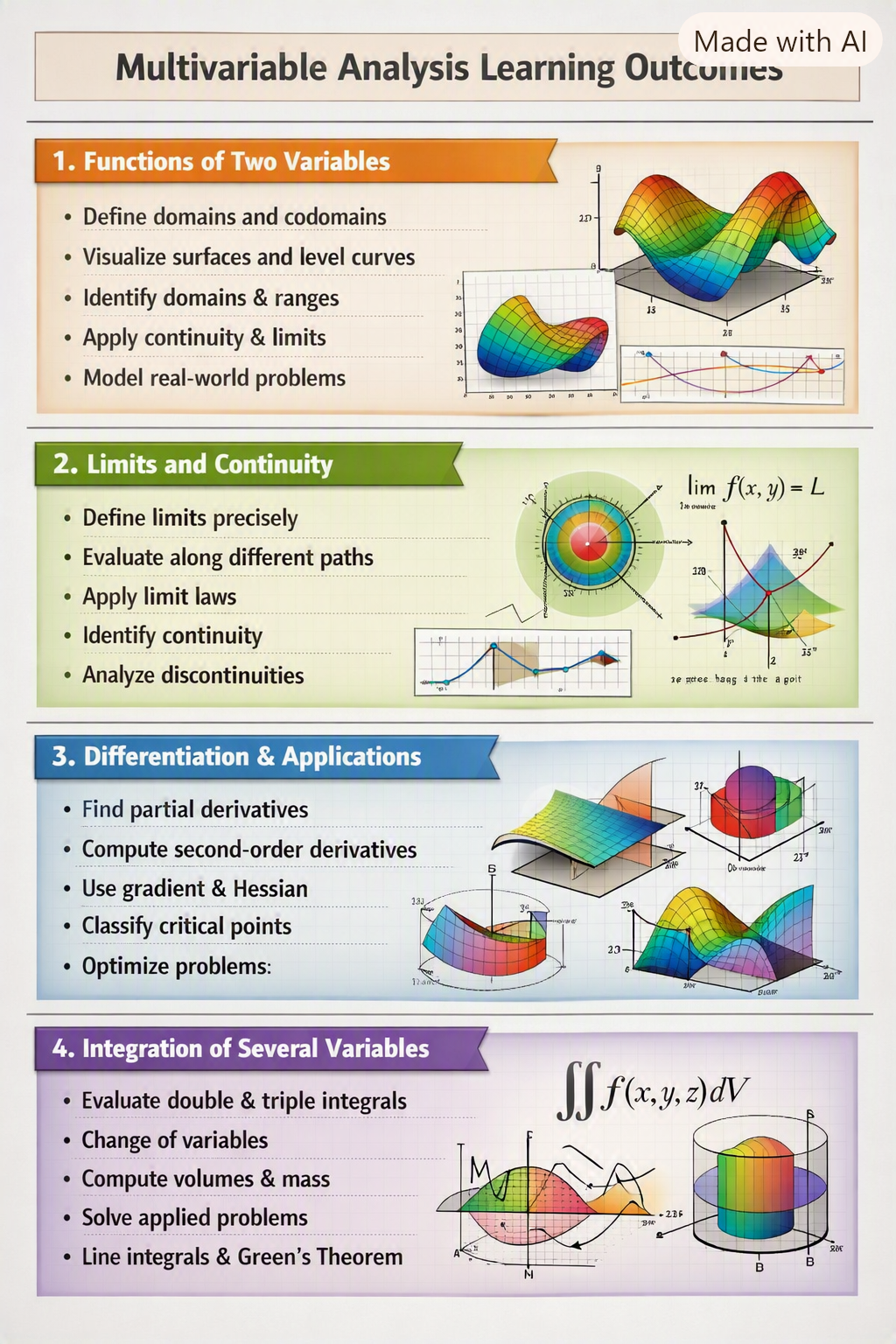
**Multivariable Analysis** provides a rigorous study of the fundamental concepts and principles underlying the analysis of functions of two or more real variables. The course develops students' understanding of two-variable functions, including their domains, codomains, and mapping rules, as well as their visualization through tables, graphs, surfaces, and level curves.
The course introduces the concepts of limits and continuity in several variables, emphasizing both intuitive and rigorous approaches, including the formal ε–δ definition of a limit and path-based reasoning to determine existence or non-existence of limits. Students examine continuity and discontinuity of functions over points and regions, using neighborhood and open set concepts, and develop the ability to classify discontinuities and justify analytical results using appropriate mathematical arguments.
The course further develops the theory and applications of differentiation for functions of several variables, including partial derivatives, higher-order and mixed derivatives, and differentiation rules such as the product, quotient, and chain rule. Emphasis is placed on the geometric interpretation of derivatives through tangent planes and curvature, the construction and analysis of Hessian matrices, and the classification of critical points using the second derivative test.
The course also covers the application of differentiation to optimization problems, including constrained optimization using Lagrange multipliers. Throughout the course, students are encouraged to develop rigorous mathematical reasoning, analytical thinking, problem-solving skills, and the ability to construct and justify mathematical arguments. Applications of multivariable analysis to real-world problems such as optimization, physical phenomena, heat distribution, and fluid flow are incorporated where appropriate.
The course introduces the concepts of limits and continuity in several variables, emphasizing both intuitive and rigorous approaches, including the formal ε–δ definition of a limit and path-based reasoning to determine existence or non-existence of limits. Students examine continuity and discontinuity of functions over points and regions, using neighborhood and open set concepts, and develop the ability to classify discontinuities and justify analytical results using appropriate mathematical arguments.
The course further develops the theory and applications of differentiation for functions of several variables, including partial derivatives, higher-order and mixed derivatives, and differentiation rules such as the product, quotient, and chain rule. Emphasis is placed on the geometric interpretation of derivatives through tangent planes and curvature, the construction and analysis of Hessian matrices, and the classification of critical points using the second derivative test.
The course also covers the application of differentiation to optimization problems, including constrained optimization using Lagrange multipliers. Throughout the course, students are encouraged to develop rigorous mathematical reasoning, analytical thinking, problem-solving skills, and the ability to construct and justify mathematical arguments. Applications of multivariable analysis to real-world problems such as optimization, physical phenomena, heat distribution, and fluid flow are incorporated where appropriate.
- Lecturer: Vincent UWAYEZU
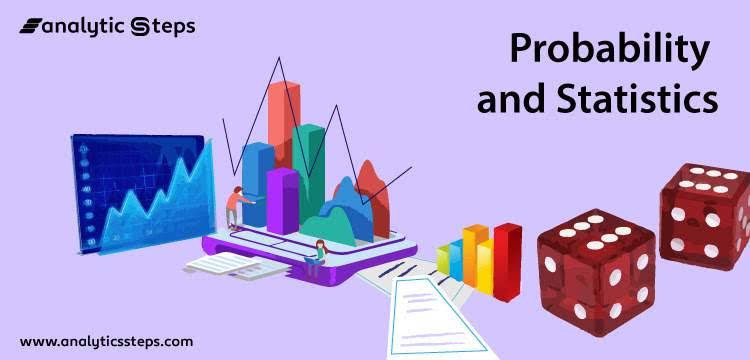
An "Introduction to Statistics and Probability" module typically covers the fundamental concepts of both fields, including basic probability theory, conditional probability, and various discrete and continuous probability distributions. It also introduces descriptive statistics, sampling methods, confidence intervals, and hypothesis testing for making inferences from data. The module often includes applications like correlation and regression, and hands-on data analysis using statistical software such as R
- Lecturer: Olivier DUKUZIMANA
- Lecturer: Fabien Habiyaremye
- Lecturer: Benjamin HAFASHIMANA
- Lecturer: Jean Claude HARINDIMANA
- Lecturer: Josephine NISHIMWE
- Lecturer: DIDACE NIZEYIMANA