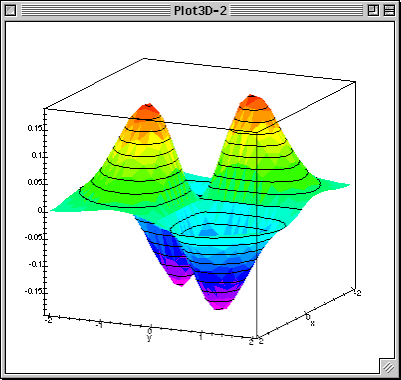
Multivariable calculus extends the principles of single-variable calculus to functions of multiple independent variables, beginning with partial derivatives which measure how a function changes with respect to one variable while holding all others constant. These partial rates of change combine to form the gradient vector, which points in the direction of the steepest ascent and generalizes the single-variable derivative to help locate local extrema, saddle points, and constrained optimization boundaries via Lagrange multipliers. Transitioning from rates of change to accumulation, multiple integrals (double and triple integrals) evaluate the volume, mass, or center of mass under multi-dimensional surfaces, often requiring coordinate transformations into polar, cylindrical, or spherical systems to simplify calculation bounds. Finally, the field culminates in vector calculus, which models fluid flow, force, and electromagnetism through line and surface integrals, governed by foundational unifying theorems—such as Green's, Stokes', and the Divergence theorem—that directly connect vector field behavior across a region's boundary to the interior of the region itself.
- Lecturer: Olivier DUKUZIMANA
- Lecturer: Jean De Dieu IRADUKUNDA
- Lecturer: Valens Munyabugingo
- Lecturer: Josephine NISHIMWE
This course introduces the fundamental principles and practices of effective teaching. It focuses on key teaching methods, lesson planning, classroom management, assessment strategies, and learner-centered approaches that support meaningful learning. The course is designed for pre-service teachers, in-service teachers, and anyone interested in developing teaching skills. No prior teaching experience is required; however, a willingness to participate actively and reflect on practice is expected. The course prepares learners to confidently plan, deliver, and evaluate instruction in diverse educational settings.
- Lecturer: Antoine GATERA
- Lecturer: Maurice HABANABAKIZE
- Lecturer: Daniel HABIYAMBERE
- Lecturer: Dr. Moses KIMANTHI
The Genetics module explores the molecular basis of heredity, Mendelian inheritance, and population genetics. It covers DNA as genetic material, genes and chromosomes, patterns of inheritance, genetic crosses, probability in genetics, genetic variation, allele frequencies, and the Hardy–Weinberg principle. The module also examines the applications of genetics in medicine, agriculture, evolution, and society.
- Course creator, Lecturer: Solange Dr Nyiraguhirwa
- Lecturer: JEAN PAUL NIYONSHUTI
- Lecturer: FABIEN NKURIKIYIMANA
- Lecturer: Fabien NSANZABERA