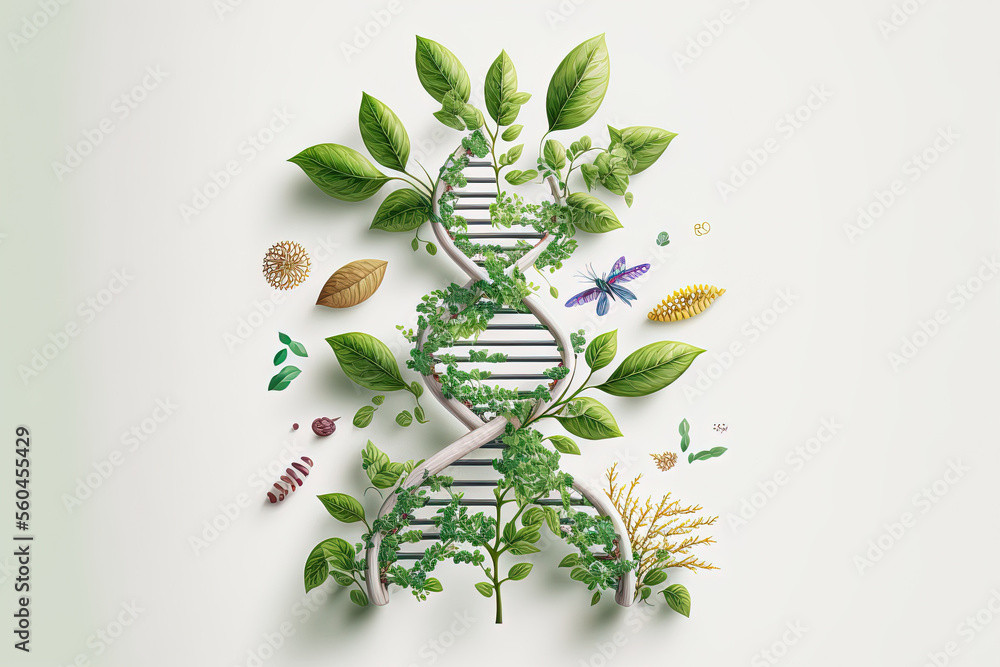
This module of Applied Biology brings together four foundational units—Molecular Biology and Biotechnology, Industrial Microbiology, Sericulture, and Freshwater Aquaculture—each of which explores different yet interconnected aspects of applied biological sciences. Together, they provide a comprehensive understanding of essential concepts, practical techniques, and real-world applications, making this handout an invaluable resource for students, researchers, and professionals in life sciences and related fields.
The unit on Molecular Biology and Biotechnology probes into the molecular mechanisms underlying biological processes, equipping readers with the knowledge of cutting-edge techniques such as gene editing, protein engineering, and molecular diagnostics. This section also explores the rapidly evolving field of biotechnology and its applications in health, agriculture, and industry.
The Industrial Microbiology unit focuses on the use of microorganisms in industrial processes, ranging from the production of pharmaceuticals, biofuels, and food products to the development of bioremediation techniques. Emphasizing the importance of microbial metabolism, genetics, and large-scale fermentation, this unit connects basic microbiological knowledge to practical industrial solutions.
Sericulture highlights the fascinating world of silkworm farming and silk production, exploring the biology of silkworms, the cultivation process, and its socioeconomic importance. This unit provides insight into both traditional practices and modern advancements in sericulture, making it relevant to agricultural sciences and rural development.
The unit on Freshwater Aquaculture examines the principles and practices of fish farming, with an emphasis on sustainable aquaculture techniques. Readers will learn about fish biology, breeding, nutrition, and water management, while also understanding the role of aquaculture in food security and livelihoods, particularly in regions like Africa and Rwanda
The unit on Molecular Biology and Biotechnology probes into the molecular mechanisms underlying biological processes, equipping readers with the knowledge of cutting-edge techniques such as gene editing, protein engineering, and molecular diagnostics. This section also explores the rapidly evolving field of biotechnology and its applications in health, agriculture, and industry.
The Industrial Microbiology unit focuses on the use of microorganisms in industrial processes, ranging from the production of pharmaceuticals, biofuels, and food products to the development of bioremediation techniques. Emphasizing the importance of microbial metabolism, genetics, and large-scale fermentation, this unit connects basic microbiological knowledge to practical industrial solutions.
Sericulture highlights the fascinating world of silkworm farming and silk production, exploring the biology of silkworms, the cultivation process, and its socioeconomic importance. This unit provides insight into both traditional practices and modern advancements in sericulture, making it relevant to agricultural sciences and rural development.
The unit on Freshwater Aquaculture examines the principles and practices of fish farming, with an emphasis on sustainable aquaculture techniques. Readers will learn about fish biology, breeding, nutrition, and water management, while also understanding the role of aquaculture in food security and livelihoods, particularly in regions like Africa and Rwanda
- Lecturer: Juvenal SINGIRUMUKIZA
- Course creator, Lecturer: Aimable MWISENEZA
- Lecturer: Jean Claude HARINDIMANA
- Lecturer: Alexis MANISHIMWE
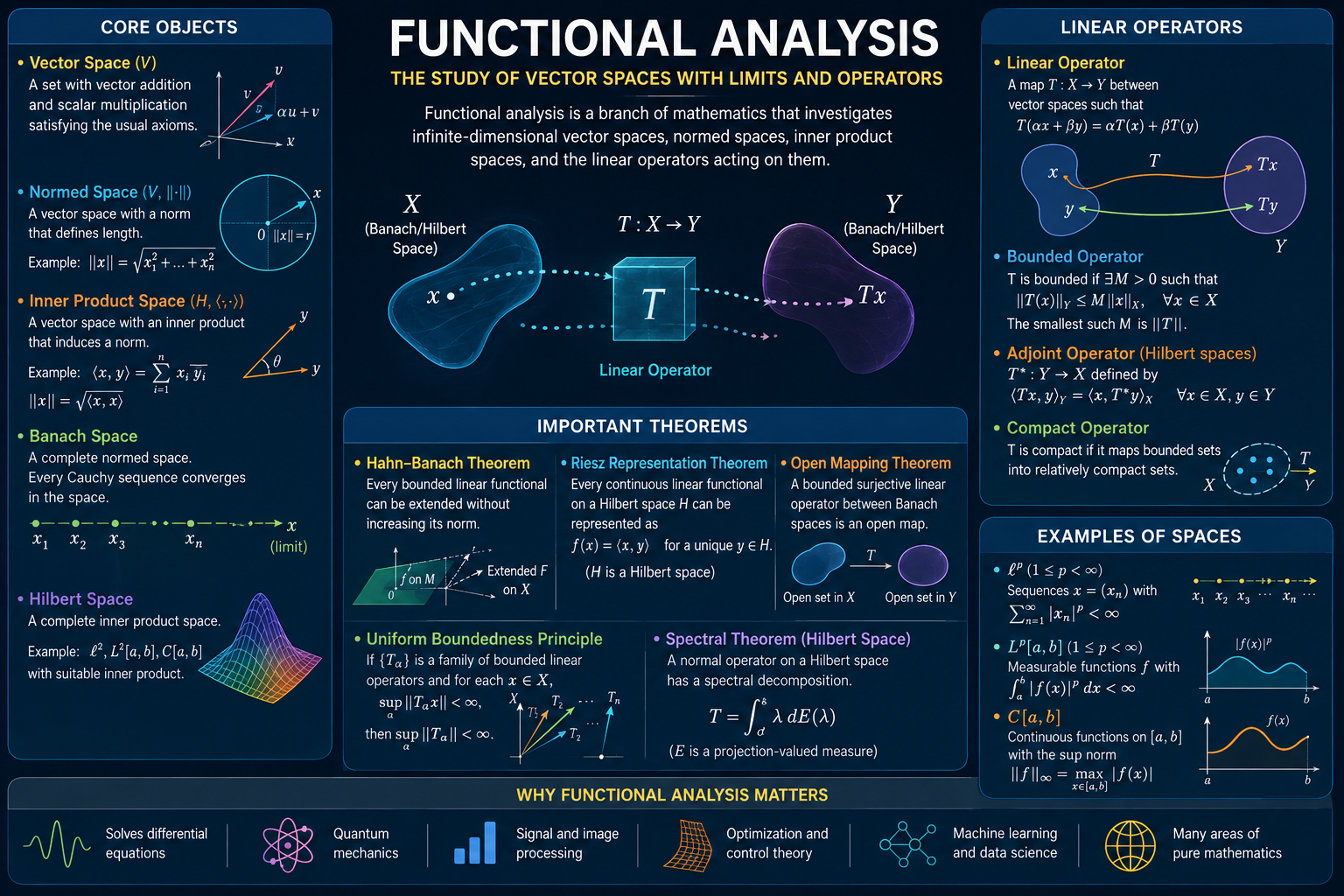
Functional analysis is a branch of mathematics that studies functions and operators on infinite-dimensional spaces. It focuses on how these objects behave under conditions like continuity, convergence, and boundedness.
Key ideas include:
Normed and metric spaces (measuring “size” and distance)
Banach spaces (complete normed spaces)
Hilbert spaces (complete inner-product spaces, with geometry like angles and projections)
Linear operators (especially bounded and unbounded operators)
Spectra and eigenvalues (how operators act through their characteristic values)
Fixed-point and existence theorems (showing solutions to equations exist)
Common applications are in differential equations, quantum mechanics, and signal processing.
Key ideas include:
Normed and metric spaces (measuring “size” and distance)
Banach spaces (complete normed spaces)
Hilbert spaces (complete inner-product spaces, with geometry like angles and projections)
Linear operators (especially bounded and unbounded operators)
Spectra and eigenvalues (how operators act through their characteristic values)
Fixed-point and existence theorems (showing solutions to equations exist)
Common applications are in differential equations, quantum mechanics, and signal processing.
- Lecturer: Benjamin HAFASHIMANA
- Lecturer: Jean Claude HARINDIMANA
- Lecturer: Alexis MANISHIMWE
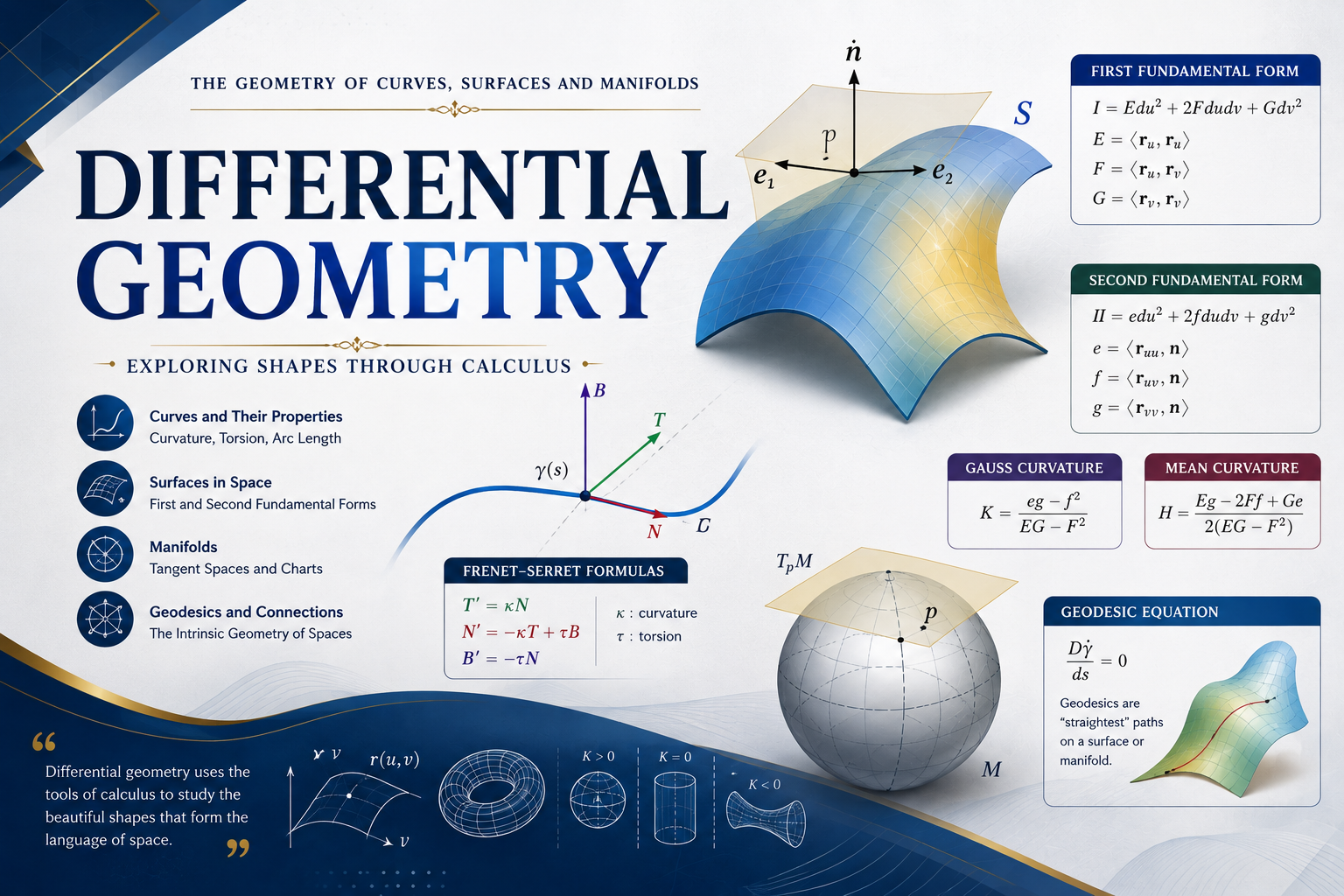
Differential Geometry studies the properties of curves, surfaces, and manifolds using calculus, linear algebra, and analytic geometry. It covers parametrization, tangent vectors, arc length, curvature, torsion, and the Frenet–Serret frame. It also analyzes surfaces via fundamental forms, curvature, geodesics, and Riemannian geometry with connections and Christoffel symbols.
- Lecturer: Benjamin HAFASHIMANA
- Lecturer: Jean Claude HARINDIMANA